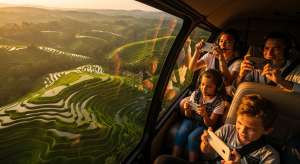
How Much is a Private Helicopter Flight Over Bali?
- Flight Duration: Shorter 30-minute coastal tours are at the lower end, while 90-minute grand volcano and island tours command the highest prices.
- Helicopter Model: A 4-seater Robinson R66 is more economical, whereas a larger, 6-passenger Airbus H130 increases the charter cost significantly.
- Itinerary & Landings: Custom routes, multiple landings, and remote transfers incur additional fees for fuel, permits, and ground support.
The thrum of the rotors vibrates through the cabin floor, a low, powerful hum that signals a departure from the ordinary. Below, the intricate mix of Seminyak’s villas gives way to a brilliant green quilt of rice paddies, stitched together by winding irrigation channels that glitter in the tropical sun. As we ascend, the entire southern peninsula of Bali unfurls, a dramatic landscape of limestone cliffs and sapphire bays. This is not merely travel; it is a recalibration of perspective. From 1,500 feet, the Island of the Gods reveals its true scale and majesty, a spectacle previously reserved for the deities it honors. For discerning travelers, the question is no longer *if* one should see Bali from the air, but rather, what is the investment for such an exclusive vantage point? The answer, like the island itself, is layered and depends entirely on the scope of your ambition.
Deconstructing the Price Tag: The Anatomy of a Helicopter Charter
When you charter a private helicopter, you are not simply paying for a ride. You are commissioning a highly complex logistical operation. As a senior editor who has covered luxury aviation for over a decade, I’ve seen firsthand that the price tag reflects a confluence of critical factors. The most significant variable is, of course, the aircraft itself. The workhorse of many Balinese fleets is the Robinson R66, a reliable turbine helicopter that comfortably seats four passengers. Its operational cost is the baseline. For a more refined experience, operators offer the Airbus H130 (formerly the Eurocopter EC130), a model I personally favor for its spacious cabin and Fenestron tail rotor, which significantly reduces noise. Chartering an H130 can increase the hourly rate by 30-40%, a premium for its superior comfort and capacity for up to six guests. This is the aircraft you choose for a multi-generational family or a celebratory flight with friends.
Beyond the hardware, the cost structure is built on a foundation of safety and expertise. Pilot proficiency is paramount. I spoke with a chief pilot for a leading Bali charter service who explained that their pilots average over 5,000 flight hours, many with military or specialized mountain flying backgrounds. This level of experience is non-negotiable and factored into the price. Then there are the operational realities: aviation fuel prices, which can fluctuate, currently hover around $6-7 USD per gallon, and a helicopter like the R66 consumes roughly 23 gallons per hour. Add to this rigorous maintenance schedules mandated by aviation authorities, comprehensive insurance policies, landing fees at designated helipads, and the salaries of the essential ground crew. What appears as a single transaction is, in fact, an all-inclusive fee for a seamless, safe, and exclusive service. A premier service like Heli Fly Bali curates these elements, ensuring every part of the operation meets the highest international standards.
The Core Itineraries: Volcanoes, Coasts, and Calderas
The cost of a private helicopter flight over Bali is directly correlated with the story you want the landscape to tell. The island’s diverse geography lends itself to several classic aerial itineraries, each with a distinct character and price point. The entry-level experience, and a magnificent one at that, is the “Uluwatu Grandeur” tour. This 30 to 40-minute flight typically costs between $2,200 and $3,500. Taking off from a helipad near the airport, you immediately track south along the Bukit Peninsula. The perspective is cinematic: the colossal 122-meter-tall Garuda Wisnu Kencana statue rises from the hills, followed by a dramatic sweep over the cliff-hanging Uluwatu Temple, where waves crash 70 meters below. From the air, you can trace the legendary surf breaks—Padang Padang, Bingin, Impossibles—and appreciate the geometry of the five-star resorts carved into the limestone.
For those seeking a more profound encounter with Bali’s spiritual heartland, the “Kintamani Volcano Experience” is the definitive choice. This 60 to 75-minute journey, priced from $4,500 to $6,000, is a pilgrimage into the island’s geological soul. The flight path heads north from the coast, crossing the patchwork of rice terraces in the Tegallalang area before ascending towards the highlands. The reveal is striking: the vast, 13.8 by 10-kilometer caldera of Mount Batur. You will circle the active volcanic cone, peering into its crater, and soar over the crescent-shaped Lake Batur shimmering within the ancient crater’s walls. This area is recognized by UNESCO as a Global Geopark for its unique geology and cultural significance. The return flight often provides an aerial view of Ubud’s river valleys, completing a comprehensive survey of Bali’s iconic landscapes.
Beyond Sightseeing: Charters for Transfers and Bespoke Journeys
While scenic tours are the most popular application for a private helicopter flight over Bali, the utility of vertical lift extends far beyond tourism. For the time-conscious traveler, helicopter transfers are the ultimate luxury. A drive from Ngurah Rai International Airport (DPS) to a secluded villa in Ubud or Uluwatu can take anywhere from 90 minutes to over two hours, depending on Bali’s notorious traffic. The same journey by helicopter is a serene 15 to 20-minute flight. These point-to-point transfers start at around $1,800 for a one-way trip in an R66, a price many high-net-worth individuals find reasonable for the time saved and stress eliminated. It allows you to begin your holiday the moment you clear customs, trading traffic jams for panoramic views.
The bespoke capabilities of helicopter charters are where true exclusivity lies. The Heli Fly Bali network facilitates connections to operators specializing in custom itineraries that cater to specific passions. Consider heli-golfing, where you are whisked from your resort to the award-winning Bali National Golf Club for a morning round, or a surprise proposal flight that culminates in a landing at a private clifftop helipad set with champagne. Island hopping becomes effortlessly chic; a transfer from Bali to Gili Trawangan in Lombok, which normally involves a car and a fast boat, is reduced to a 45-minute flight. For the truly adventurous, charters can be arranged to more remote destinations like Moyo Island, home to the exclusive Amanwana resort. These custom charters are priced on a case-by-case basis, factoring in flight time, standby hours for the pilot and aircraft, and any special landing permits required. The investment reflects a level of personalization and access that is simply unattainable through conventional means.
The Aircraft Matter: A Closer Look at Your Aerial Carriage
In the world of private aviation, the machine is as much a part of the experience as the destination. Choosing the right helicopter for your flight over Bali impacts comfort, capacity, and cost. The most common aircraft you’ll encounter is the Robinson R66 Turbine. Think of it as the Porsche 911 of the skies: nimble, powerful, and efficient. It seats a pilot plus four passengers, though for optimal comfort, it’s best for groups of three. Its single Rolls-Royce RR300 turbine engine provides a smooth ride with a cruising speed of approximately 120 knots (222 km/h). The R66 offers excellent visibility and is the most cost-effective option for small groups and couples, making it the backbone of scenic tour operations across the island. Its proven safety record and reliability make it a trusted choice for operators worldwide.
For those who prefer to travel with a larger party or demand a higher level of luxury, the Airbus H130 is the unequivocal upgrade. This is the Bentley Continental of light helicopters. Its spacious, theatre-style cabin seats a pilot and up to six passengers, with all seats facing forward for unobstructed, panoramic views. The key differentiator, as noted by aviation enthusiasts, is its Fenestron shrouded tail rotor. This advanced technology, detailed on platforms like Wikipedia, makes the H130 significantly quieter both inside and out, enhancing passenger comfort and reducing the noise footprint over populated areas. This feature, combined with its wider cabin and superior vibration control, makes it the preferred aircraft for VIP transfers and premium tours. Opting for the H130 will typically add a 25-35% premium to the charter cost, a justifiable expense for the elevated experience it delivers.
Insider Tips for an memorable Aerial Experience
Having arranged and experienced dozens of these flights globally, I’ve learned that a few insider details can elevate a great flight to an memorable one. First, timing is critical. The “golden hours”—the first hour after sunrise and the last hour before sunset—offer the most dramatic lighting for photography. The low-angled sun casts long shadows, accentuating the contours of the rice terraces and making the ocean glow. Be aware of Bali’s climate: the dry season (May to September) generally offers the clearest skies and best visibility. During the wet season (October to April), afternoon showers are common, so booking a morning flight is a strategic move. A reputable operator will always prioritize safety and will reschedule if weather conditions, including volcanic ash advisories from Mount Agung, are not optimal.
Second, consider your group’s composition to maximize value. While a flight for two in a Robinson R66 is an intimate experience, chartering a larger Airbus H130 with a group of five or six people can significantly lower the per-person cost, making a top-tier experience more accessible. Always communicate your primary interests to your charter specialist. If you’re an avid photographer, they can request the pilot remove the doors (on certain aircraft models, weather permitting) for reflection-free shots. If it’s a romantic occasion, they can arrange for specific flight paths. According to the official Indonesia Travel portal, Bali’s appeal is its diversity, and a helicopter tour should reflect your personal vision. Booking 4-6 weeks in advance is highly recommended, especially during the peak tourist months of July, August, and December, when aircraft availability is limited. This lead time allows for better scheduling and personalization.
Quick FAQ: Your Bali Helicopter Questions, Answered
What is the typical baggage allowance on a helicopter transfer?
Baggage is strictly limited due to weight and balance constraints. The standard allowance is one soft-sided bag or carry-on per person, with a maximum weight of 10-15 kg (22-33 lbs). Hard-shell suitcases are generally not permitted as they don’t fit well in the limited cargo space. Always confirm the specific allowance for your chosen aircraft with your charter provider.
Are flights guaranteed to fly, or are they weather-dependent?
All flights are highly weather-dependent. Safety is the number one priority. Flights will be postponed or rescheduled in the event of heavy rain, low clouds, high winds, or volcanic ash activity. Reputable operators will offer a full refund or the option to reschedule if a flight is canceled due to weather.
Can we land anywhere we want, like on a private beach?
No. Helicopter landings are restricted to registered helipads, airports, and pre-approved private landing sites that have been surveyed for safety. Spontaneous landings on beaches, in fields, or at temples are not permitted due to safety regulations and respect for private and sacred land. Any custom landing must be arranged and permitted well in advance.
What is the best seat for views and photography?
In most helicopters, the seat next to the pilot offers excellent forward and side views. In the Airbus H130, all seats are designed to have a good view, but the front seats are generally considered premium. For the Robinson R66, the front seat and the back-right seat typically offer the best perspectives for photography. Discuss your preference when booking, as seating is often determined by weight distribution for flight balance.
A private helicopter flight over Bali is far more than a simple tour; it is an investment in perspective. It’s the opportunity to witness the island’s epic scale, from the volcanic peaks that pierce the clouds to the turquoise reefs that guard its shores, all within a single, seamless journey. This is the definitive way to comprehend the sheer diversity and beauty of this unique destination. To begin curating your own aerial journey and explore the possibilities, the specialists at the Heli Fly Bali Network are the premier resource for connecting discerning travelers with the island’s most elite aviation experiences.